

How LED and LCD counter and main displays compare on visibility, flexibility, cost and maintenance – and how to combine them.
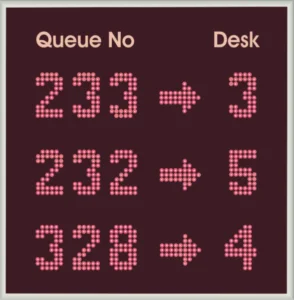
Every queue system needs displays: one above every counter and at least one main display in the waiting hall. The choice is usually between LED and LCD. Both work well – they just suit various situations.
LED displays
LED displays show numbers (and with dot-matrix models, text and arrows) utilising bright light-emitting diodes.
- Really readable from a distance and in bright rooms.
- Long life and low power use.
- Lower cost per counter.
- Limited to numbers, short text and straightforward graphics.
Examples: the CD-1040-EL counter display and the multi-row QMG-1048×3 main display.
LCD displays
LCD screens display anything – numbers, service names, logos, videos and news.
- Flexible layouts that can change by time of day.
- Digital signage alongside queue calls.
- Multi-language text without extra hardware.
- Higher cost and need more care in extremely bright locations.
Examples: the D-LCD-215 counter screen and the 58″ D-LCD-580.
A common combination
Numerous sites use LED counter displays – simple, bright, affordable – and a sizeable LCD main display that combines calls with details and promotions. Banks and telecom shops frequently go LCD everywhere to keep their branding consistent.
Questions to decide
- How far away will service users be sitting?
- Do you would like to display anything besides numbers?
- How bright is the room?
- What matters more: lowest cost per counter, or one consistent branded look?
Browse all counter displays and main displays, or read more about digital signage.
You may also like
Sıramatik Nedir? Sıra Yönetim Sistemi Rehberi
Sıramatik ve sıra yönetim sistemi nedir, hangi parçalardan oluşur, nasıl çalışır? Kurum ve işletmeler için pratik rehber.
What Is a Queue Management System? A Hands-on Handbook
What a queue management system is, which parts it has, how it works one step at a time and how to tell whether your institution needs one.

7 Ways to Cut Patient Wait Time in Hospitals
Hands-on steps clinics and hospitals can take to shorten patient wait times, from multi-step patient flow to appointment mixing and live monitoring.